It answers from what you have written, hands over the moment it should, and never surprises you with a bill for being useful.
An AI chatbot with human handoff answers customer questions automatically and transfers the conversation to a person when it cannot help. The inrelay chatbot answers live-chat visitors from your knowledge base and sources, declines the subjects you mark off-limits, and hands off to a named teammate with the whole conversation attached.
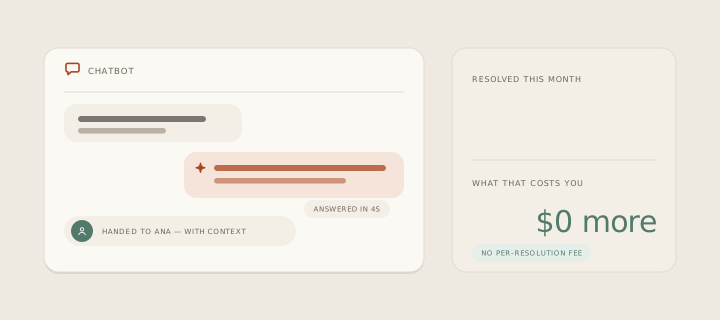
What it prevents is the loop. Everyone has argued with a bot that would not let go — rephrasing the same question four times, hunting for the word that unlocks a human. A chatbot is only worth having if the exit is as good as the answer, which is why the handoff on this page gets more attention than the answering does.
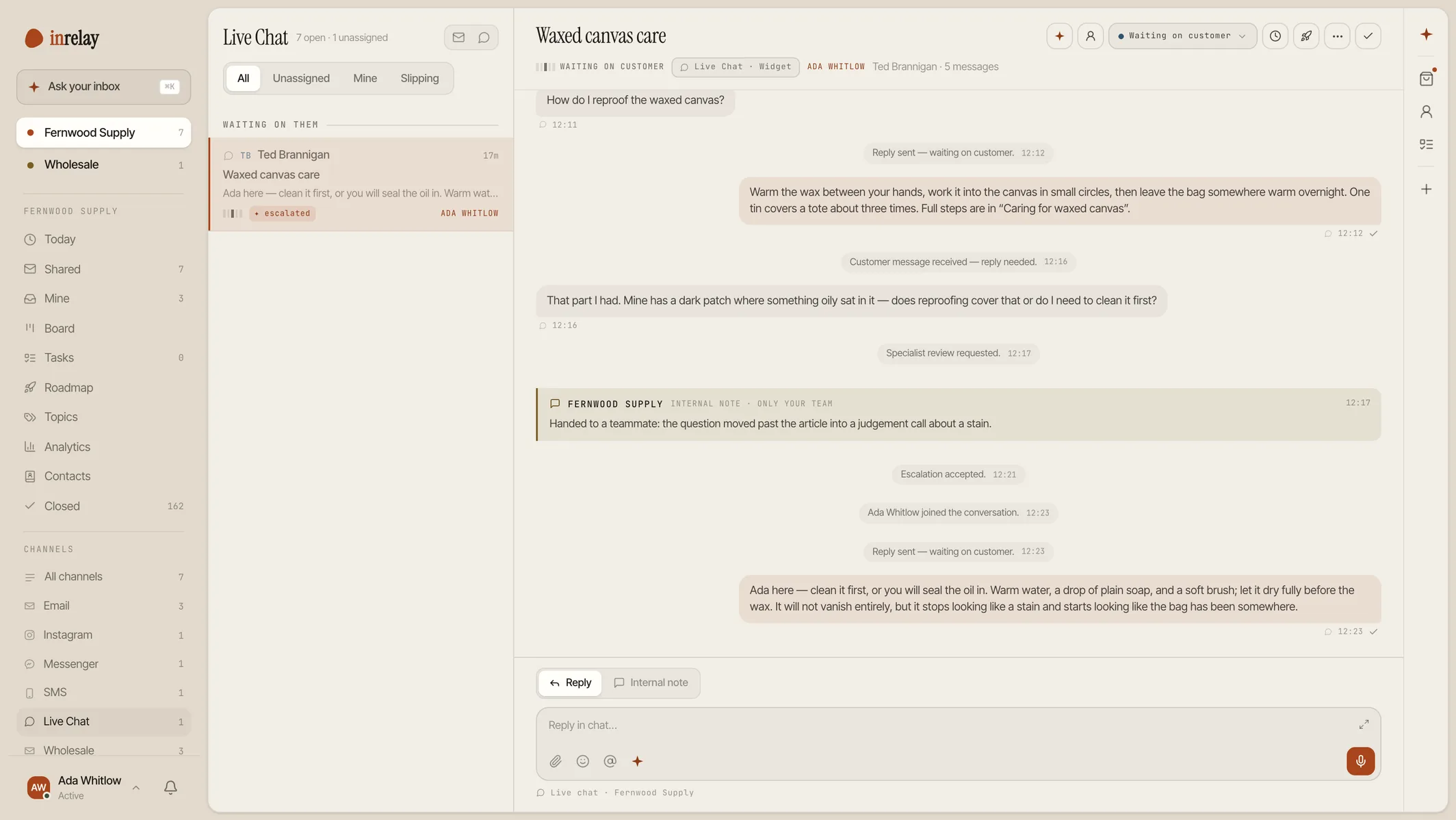
The chatbot answers from your own material — published help articles and the knowledge sources you have added — rather than from a model’s general impression of your business.
That grounding is a setting, not a hope. Each source you add carries its own switch for whether the chatbot may cite it, so an internal policy document can inform your team without ever reaching a customer. When the search finds nothing solid, the bot does not improvise — it escalates.
A handoff in inrelay is not a message saying somebody will be in touch. It is a real escalation — a change of state on the conversation: the thread is marked as waiting on your team, it starts needing a reply, any snooze is cleared, and — if you named one — it lands on a specific teammate while everybody else is still notified that it happened.
Three things trigger it. The visitor asks for a person. The question touches a subject you marked restricted. Or the bot has gone several messages without resolving anything and you have told it to stop trying. In each case it says the handoff line you wrote, and it can collect an email first so the conversation survives the visitor closing the tab.

Every one of these is a field on one settings page, not a support ticket to us:
That last one is the whole trust argument in one field, so it is worth being precise about: the budget is a ceiling you choose, and running into it costs you nothing but the bot going quiet.
For a team of one to five, the chatbot is not about deflection targets. It is about the eleven hours a day nobody is at a desk. A visitor with a sizing question at midnight either gets an answer from your own help article or leaves; there is no third option where you wake up and catch them. For ecommerce and DTC teams that hour is where most of the “where is my order?” volume lands.
The reason to be careful about which answers it gives is the same reason to have it at all. Getting a wrong answer at midnight is worse than getting none — so the shape that works is a bot confined to what you have actually written, with a short leash and a fast exit to a human.
The rest of the category bills the bot by the answer. Intercom’s Fin charges $0.99 per resolution, Help Scout $0.75, Zendesk $1.50 to $2.00, and Gorgias meters an AI resolution and the ticket underneath it. The arithmetic is uncomfortable once you see it: a good month for your business is an expensive month for your support bill, and the tool you bought to save money charges most exactly when you are busiest.
No per-resolution fees. Ever. The agent’s work comes with the plan. You set your AI budget. The reply budget is a number you type, visible before the bot goes live and changeable after. No silent upgrades. Nothing about a busy December moves you onto a bigger plan on its own.
What that buys, besides money, is a chatbot you can be relaxed about. When every bot answer is a charge, the incentive quietly runs the wrong way — the vendor wants the bot to resolve, and you want it to hand off. Here nobody is paid by the answer, so the only question left is whether the answer was any good.
Competitor rates as of August 2026, from the vendors’ own pricing pages — the same set used on pricing.
Publish a few help articles or add a source — your site, your docs, a policy document. The bot answers from these and nothing else.
Name the restricted topics and the teammate escalations should land on, and write the handoff line in your own words.
Choose the monthly reply budget and whether the bot works all day or only after hours. Start at a small rollout percentage if you would rather watch first.
Every bot conversation is in your inbox like any other. The ones it got wrong are usually a missing article, not a broken bot. The help docs cover each setting.
The chatbot is on every plan, including the free one — governed by the reply budget you set, never by a per-answer charge.
The chatbot is one piece of the inrelay feature family — these are its closest neighbours.
The bot is exactly as good as your help centre. Every article you publish is another question it can take.
See the knowledge base → THE PROMISEOn email and tickets the agent drafts and waits. Nothing reaches a customer without a person deciding.
The approval model → LIVE CHATChat on your site, with humans and the bot sharing one queue and one history.
See live chat →Free to start with your own inbox — every feature, no card, never per seat.
Give your customers faster answers and your team their evenings back.
Desktop and mobile. Free for solo.