SLA & business hours

SLA tracking software that knows when you close

Promise a response time, and let the inbox hold you to it — on a clock that stops when your day does.

Shipping soon
The short answer

SLA tracking software holds a support team to the response times the team promised: a deadline on every conversation, a visible countdown, and a warning before anything is missed. inrelay puts a next-action deadline on each conversation and reads urgency straight from the clock — with targets set per channel and timers that pause outside business hours.
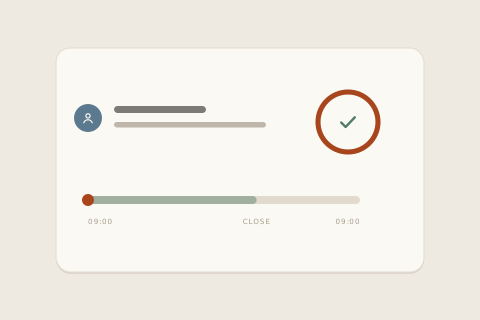
Looping animation: the SLA clock starts, pauses while the conversation is closed, and the reply goes out inside the promise.

What it prevents is the silent broken promise: the Friday-evening email that sat politely in a first-in-first-out queue all weekend, discovered on Monday by an angry follow-up instead of a timer.
01 · The deadline

How it works in inrelay

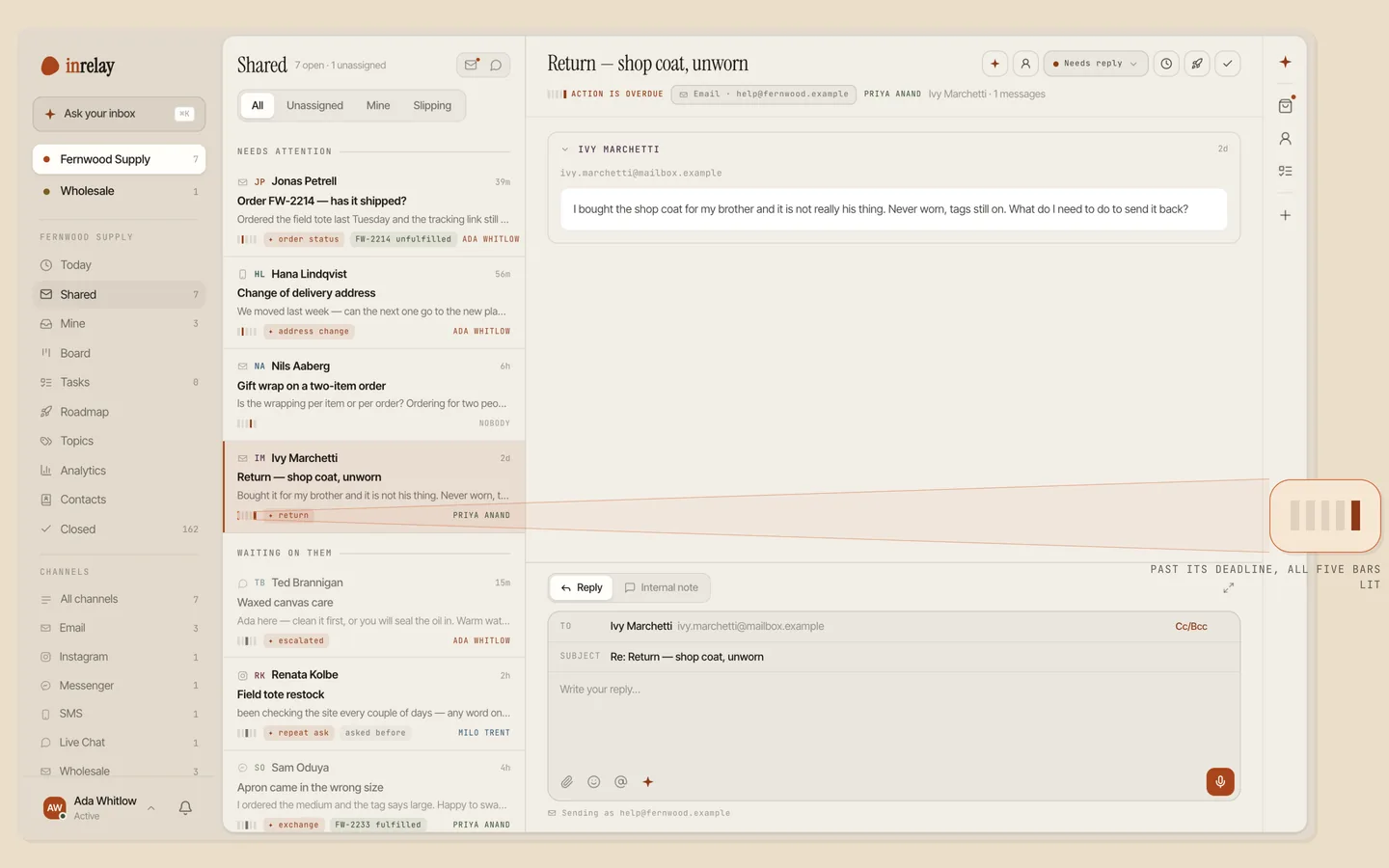
Every conversation in inrelay carries a next-action deadline, and the inbox derives urgency from it — the same way on desktop and mobile.

The inbox list with a five-bar urgency indicator on every conversation, one of them past its deadline with all five lit, magnified in a detail panel
  • A deadline on every conversation. Each thread records when its next action is due, alongside who it’s waiting on and whether it needs a reply.
  • Urgency nobody can argue with. It’s a read-only result of the clock, not another status someone sets — a thread can’t be talked out of being late.
  • Slipping before late. The five-bar indicator fills as the deadline nears, so the warning arrives while the promise can still be kept.
  • Targets in your words, per channel. First reply on live chat in minutes, email in hours — and every new conversation gets its deadline set for it, automatically.
  • The deadline engine runs in the product today; named SLA policies on top of it are the part still in development.
02 · The promise

What an SLA actually is

Service level agreement. A service level agreement (SLA) is a stated promise about how quickly a support team responds — for example, first reply within four business hours. SLA tracking software makes the service level agreement operational: it attaches the promised deadline to each conversation and surfaces the conversations at risk of breaking the promise.

The promise is yours; the software’s job is keeping it visible. For the full term — where SLAs come from and how breach rates are measured — see the SLA glossary entry.

03 · Business hours

Timers that respect your working day

A four-hour target with a naive clock is a trap: the message that lands at 5:50pm on Friday is a sixty-hour “breach” by Monday morning, and once every weekend produces false alarms, the team learns to ignore the red. inrelay counts SLA time inside your business hours only — the timer stops at close, resumes at open, and the Friday-evening email is simply first in line on Monday with its four hours intact.

Those are the same working hours your help widget already uses to tell customers when you’re away — one schedule, told to customers and counted against you, honestly in both directions.

04 · Kept, not claimed

Why it matters

Without SLA tracking software, response-time promises live in people’s heads, and first-in-first-out quietly makes the decisions: a two-word “thanks!” and a customer about to cancel wait in the same line. A tracked deadline reorders the day around the promises closest to breaking — which is also what makes a small team safe to promise anything at all. Committing to “we reply within four business hours” on your help page is only credible when something is counting.

And because the deadline drives triage and routing, at-risk conversations don’t just glow — they move up the queue of the person who owns them.

05 · Set-up

Setting it up

Set your business hours

Days and hours per workspace, in your timezone. The widget uses them to set customer expectations; SLA timers use them to count.

Name your targets

First-reply time per channel — minutes for live chat, hours for email. Start looser than you think; tighten when you’re beating them.

Let deadlines set themselves

Every new conversation gets its deadline from your policy. Nothing to remember per thread.

Work the bars

Slipping threads surface before they turn late. The help docs cover every setting.

06 · Close neighbours

Works with the rest of the inbox.

SLAs lean on the wider inrelay feature family — these three most of all.

Start today

Make promises you can keep.

Free to start with your own inbox — every feature, no card, never per seat.

Questions, answered.

When does this ship?
The deadline engine underneath — a next-action deadline on every conversation, with urgency read from it — is live in the product today. The SLA policy layer on top, where you name targets per channel and business hours pause the timers, is in development. We don’t publish dates we’d have to walk back; the changelog announces launches, and you can ask for early access via contact.
What’s the difference between slipping and late?
Slipping means the deadline is close and the promise can still be kept — the five-bar indicator is nearly full and the thread is climbing the queue. Late means the deadline has passed. The point of tracking is to spend your attention on slipping, so late stays rare.
Do SLA timers count nights and weekends?
Not if you set business hours — the timer pauses at close and resumes at open, so a Friday-evening email starts Monday with its full target remaining. Run a genuine 24/7 operation and you can leave business hours off, and the clock runs continuously.

Start running your DMs.

Give your customers faster answers and your team their evenings back.

Desktop and mobile. Free for solo.