Solutions · Accounting

Shared inbox for accounting firms that live by deadlines

Every client email owned by a named person, engagements kept separate, and filing season absorbed — without a per-seat bill that punishes you for staffing up.

The short answer

inrelay is a shared inbox for accounting firms: connect info@ or admin@ once, and every client email becomes a conversation with an owner, a status and a private space for the team to confer. Access is scoped by workspace, drafts wait for a human’s approval, and pricing is flat per firm — not per staff member.

In an accounting firm, email isn’t correspondence — it’s the work. The K-1 a client finally sends, the extension question on April 12th, the third request for the same bank statements. When that lives in one partner’s personal mailbox, the firm has a single point of failure: the client who emailed only her goes unanswered the week she’s at a conference, and nobody else can even see that the thread exists.

Then filing season arrives and triples the volume, on statutory deadlines that don’t care whether the message was seen. A missed reply in July is embarrassing. A missed reply in March can cost a client a filing date.

01 · What firms need

What accounting teams actually need

Nothing slips in filing season. The surge is predictable; the tooling should absorb it. Every client message needs an owner and a visible status, so the thread that’s been waiting four days surfaces itself before the client calls the managing partner.

One record per client, across years and staff. “What did we tell them about this last year?” should be a search, not an archaeology dig through a departed senior’s mailbox.

Confidentiality scoped to the engagement. A client’s financials are among the most sensitive things a firm holds. The bookkeeping team doesn’t need to browse tax clients; a seasonal preparer needs exactly the slice of the firm they’re working, nothing more.

Document chasing that doesn’t consume partner hours. Most of a firm’s inbox is asking for things and waiting for things. The waiting needs to be visible and the asking needs to be cheap.

Routine answers off the partners’ plates. “What documents do I need for my return?” has one right answer. It shouldn’t be typed fresh, at partner rates, forty times a February.

02 · How inrelay fits

Requirement by requirement, honestly

What the firm needsHow inrelay meets it Nothing slips on deadlineEvery email gets an assignee and a status — new, needs reply, waiting, slipping — so stale threads surface on their own. Triage and routing sends each message to the right desk, and collision detection stops two staffers answering the same client differently. One record per clientThe full thread history lives in the shared workspace, with internal notes and @mentions beside each conversation — never visible to the client. When someone leaves, their threads are reassigned, not lost. Confidentiality by engagementSeparate workspaces scope who sees what, enforced with row-level security at the database layer — the security page describes exactly how, and exactly which certifications we don’t hold yet. Document chasingMark a thread waiting, snooze it to the follow-up date, and answer with saved snippets — the checklist request that used to take five minutes takes five seconds. Routine answers, cheaplyA knowledge base on your own domain answers the common questions before they become email. The AI agent drafts replies to the rest — on every plan, governed by a monthly reply budget the firm sets — and a person approves every send, because in this profession the wording is the work.

A shared inbox for accounting firms only earns its keep if the whole firm can be in it — which is why the Team plan is a flat $79 a month and teammates are never priced. Seasonal staff in January cost you nothing extra, and firms that keep each engagement in its own isolated workspace move to the Studio plan ($149+ a month per bundle of workspaces), priced on workspaces — never on seats.

03 · A March morning

One deadline week, end to end

A client replies at 9pm with half the documents you asked for and a question about her estimated payments. Overnight, the agent tags the thread, routes it to the tax workspace, and drafts two things: an acknowledgment listing exactly which documents are still missing, and an answer to the payments question pulled from how your firm has answered it before. At 8am the senior on the engagement reads both, tightens one sentence, approves. The thread flips to waiting, snoozed to Friday — when it resurfaces by itself if the documents haven’t come. The partner never opened her inbox, and the client heard back before her second coffee.
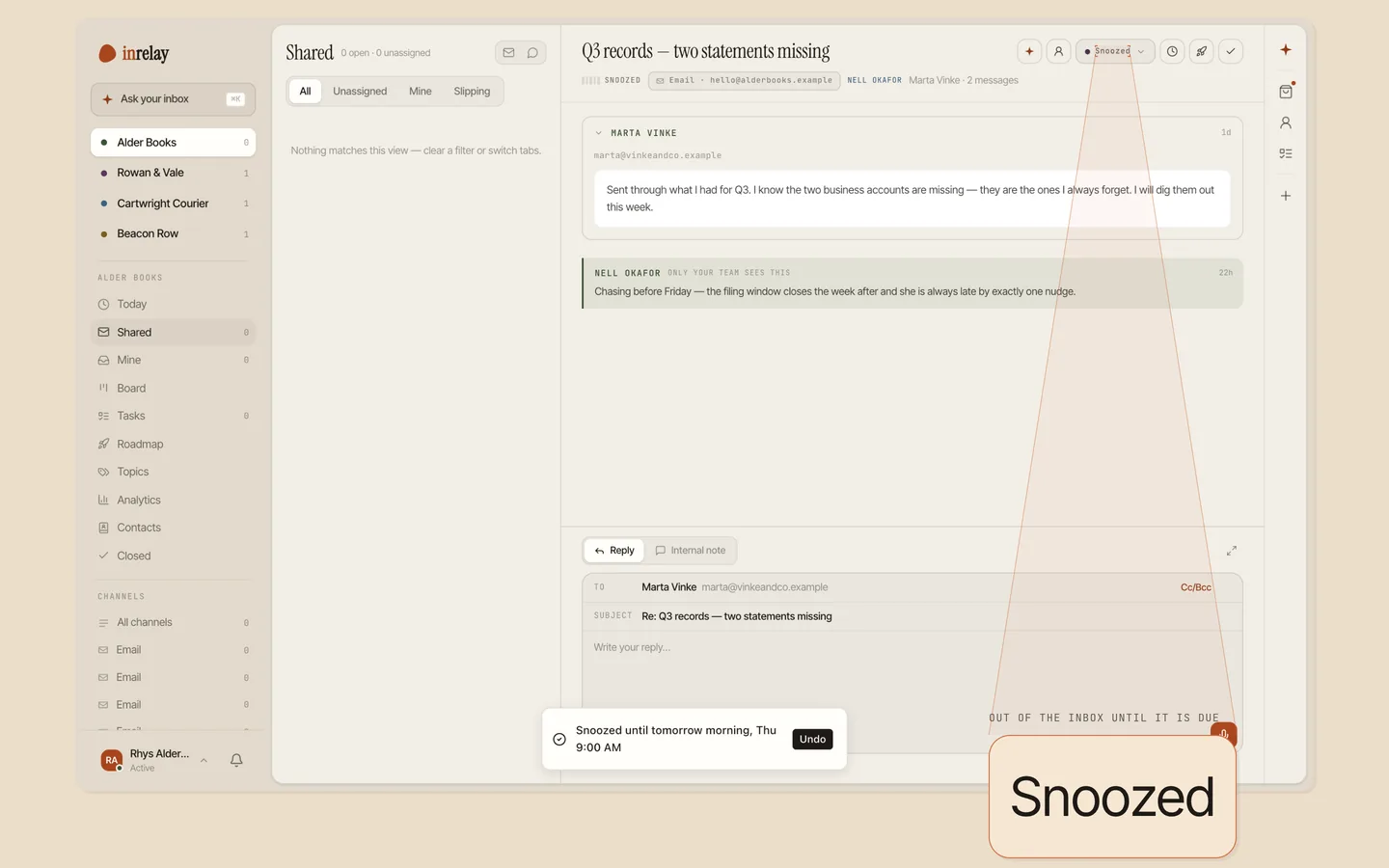
A client conversation about missing documents, snoozed out of the inbox until it is due, with the snoozed badge magnified in a detail panel
04 · Integrations

What connects today, honestly.

inrelay does not yet integrate natively with practice-management suites like Karbon, Canopy or TaxDome, and we won’t pretend otherwise. What it connects is the channel your clients actually use: your firm’s email over Gmail, Microsoft 365 or IMAP — alongside live chat on your website and a knowledge base for the questions every client asks. Your practice-management system keeps the engagement record; inrelay keeps the conversation calm.

Start today

Give every client email an owner.

Connect the firm’s address in minutes — one flat price, teammates never priced, calm by March.

Questions, answered.

Can clients tell we’re using a shared inbox?
No. Replies go out from your firm’s own address, exactly as before. Clients notice one thing: they get answered faster, and never twice with two different answers. Internal notes and @mentions are never visible to them.
Who at the firm can see a client’s emails?
Only the people you give access to that workspace. Separate teams — tax, bookkeeping, advisory — can run separate workspaces, and the separation is enforced with row-level security in the database, not just hidden in the interface. The security page states plainly what we do and which certifications we don’t hold yet.
Does filing-season volume cost us more?
No. Volume is never metered on inrelay’s flat plans — no client message is ever dropped mid-deadline, and there are no overage fees. The only number is the AI agent’s monthly reply budget, which you set and can see; if it runs out, the agent pauses drafting and the inbox keeps working. Because pricing is flat per firm, seasonal staff never add to the bill. Details on the pricing page.
Will the AI answer clients about their finances on its own?
Never. The agent triages, tags and drafts; a reply only sends when someone at the firm approves it. For advice-adjacent email, that gate isn’t a feature — it’s the requirement. Approve before send spells out what the AI never does without you.

Start running your DMs.

Give your customers faster answers and your team their evenings back.

Desktop and mobile. Free for solo.